
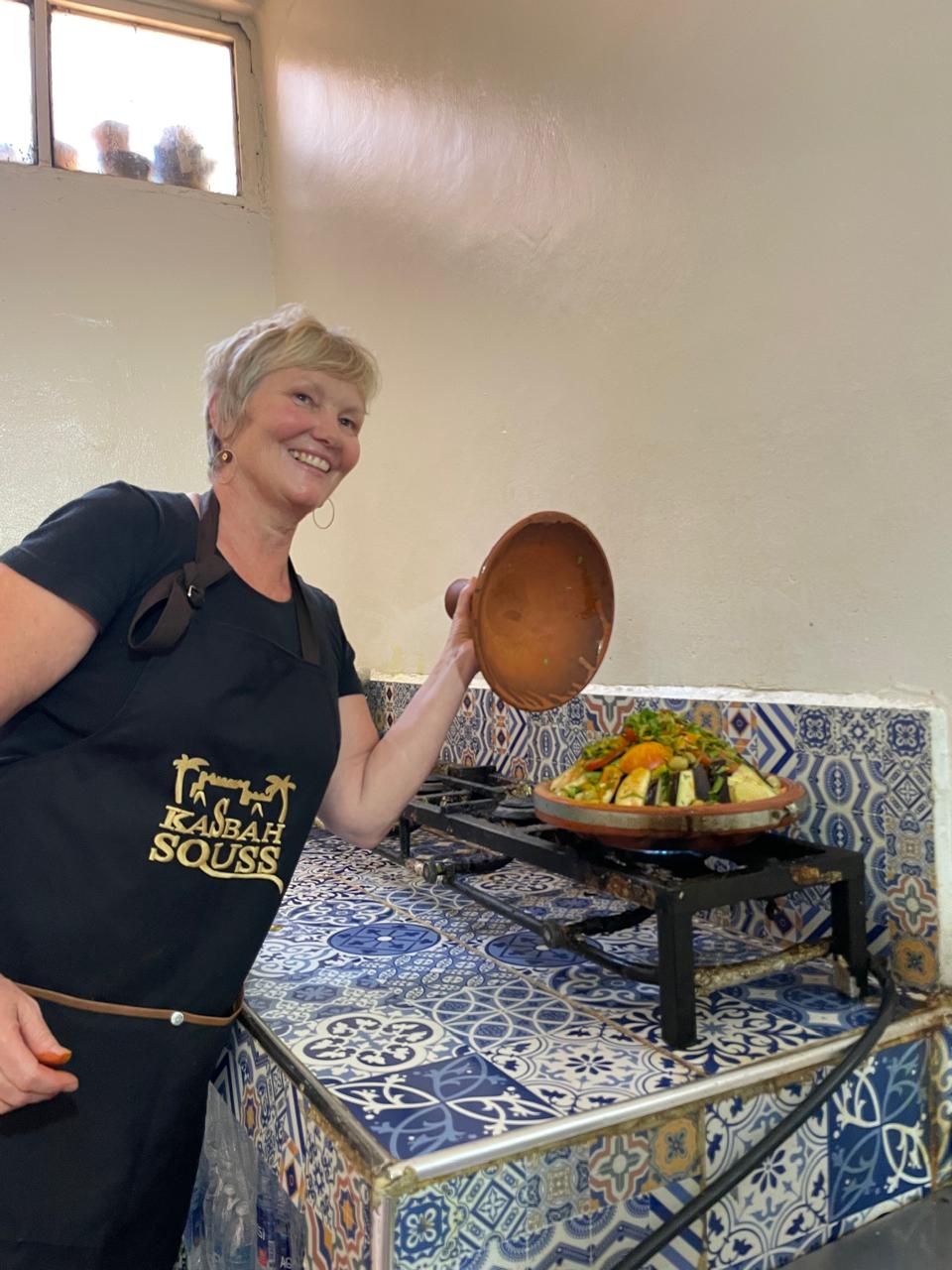
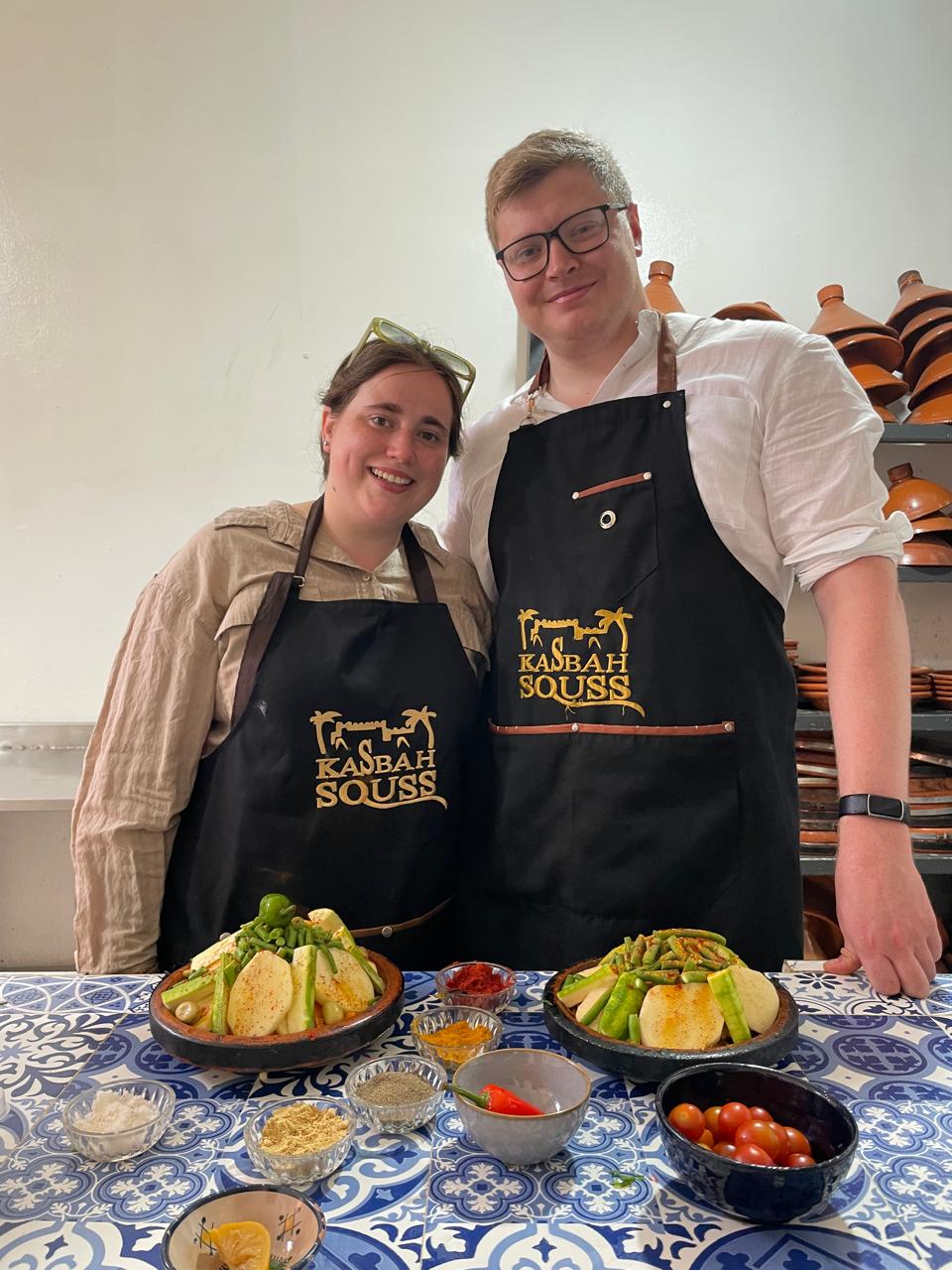
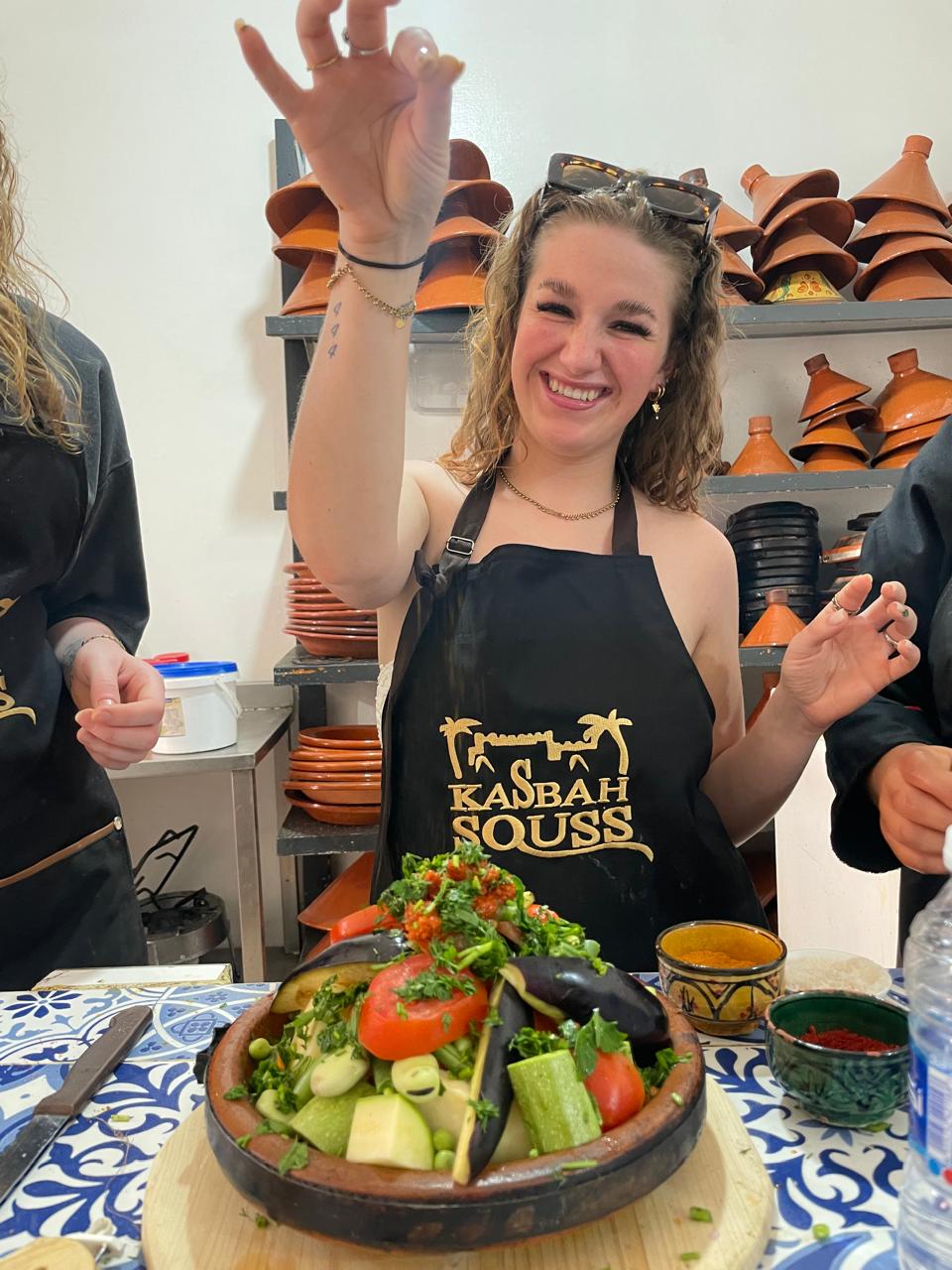
A Moroccan cooking class in Agadir costs 350 MAD (~€33) per person, lasts 4 to 5 hours, and includes a guided Souk El Had market tour, all ingredients, the hands-on cooking session, the shared meal, and free round-trip hotel pickup in Agadir and Taghazout. A tagine cooking class is a market-to-table workshop: you choose fresh produce and spices with a local host in the morning, learn slow clay-pot cooking in a traditional kitchen, and sit down at midday to eat the meal you prepared yourself.
What happens during the cooking class?
The morning starts with pickup from your hotel in Agadir or the surf village of Taghazout, twenty minutes up the coast. Your host — a local cook who grew up eating exactly the food you are about to learn — drives with you toward Souk El Had, talking through the menu while the city wakes up around you. By the time you step through one of the market's thirteen gates, you already know what you are looking for, and more importantly, why. That sense of purpose changes everything: you are not a tourist collecting photos of spice pyramids, you are a cook doing the morning shopping, and the vendors respond to that difference immediately.
Where exactly does the experience take place?
Geography matters here, because the food is inseparable from it. The experience moves between two anchor points in Agadir. The first is Souk El Had, the city's great covered market, rebuilt after the 1960 earthquake and organized behind thirteen numbered gates with more than six thousand stalls selling vegetables, olives, preserved lemons, dates, argan products, textiles, and household goods. The spice and herb quarters, where your host takes you first, sit deep inside the complex, past the olive sellers and the mint growers. The second anchor is the traditional kitchen at the Kasbat Souss artisan basecamp in Bensergaw (GPS: 30.3878232, -9.5687388), a ten-minute drive from the market, where the cooking session and the shared meal happen in calm after the market's beautiful noise. Between the two lies the Souss river valley's market-garden belt, the same farmland that fills the crates you will see stacked at the souk — and beyond it, the Agadir beachfront promenade where many guests walk off the meal in the afternoon.
Kasbat Souss is the beating heart of Amazigh craft in Agadir — hand-made everything, mint tea, and the best tagine in town.
Learn moreStep 1: Doing the morning shopping at Souk El Had
Entering the spice quarter hits all senses at once and in a specific order: first the low, warm smell of cumin toasting somewhere out of sight, then the sharper green note of wild thyme crushed underfoot, then the floral lift of dried Damascus rose petals sold for tea, and underneath it all the salty punch of preserved lemons stacked in glass jars. Your host slows the group down at each stall and teaches the small physical tests Moroccan cooks actually use: rubbing cumin between your palms to check whether the aroma blooms or falls flat, snapping a dried chili to hear whether it is still alive with oils, pressing an olive to feel whether the flesh gives back. Vendors offer tastes freely once they understand you are cooking today, not sightseeing — a spoonful of harissa here, a sliver of aged Bouhezza cheese there — and the choreography of it becomes the first lesson: shopping in Agadir is a conversation, not a transaction. You leave carrying the day's menu in cloth bags: seasonal vegetables, cilantro and flat-leaf parsley, mint, olives, olive oil, preserved lemons, and the spice measures your host weighs out in folded paper cones.
Step 2: Building the Taqliya over unglazed clay
Back at the Kasbat Souss kitchen, the first thing your host puts in your hands is the tagine base itself: unglazed red clay, heavier than it looks, cool to the touch, faintly smelling of woodsmoke from years of use. Everything that follows depends on this object, and your host treats it with a craftsman's seriousness. The aromatic base of Moroccan cooking has a name — Taqliya — and it is not a sauce so much as a foundation: sliced onions collapsing slowly in olive oil, crushed garlic, grated tomato, and the first measure of spices, stirred until the mixture turns glossy and deep. You build it yourself, with corrections delivered by hand on your wrist when your stirring rhythm is wrong: too fast and the onions steam instead of melting, too slow and the garlic catches. Chicken or vegetable pieces are layered over this base with preserved lemon and olives, water is added sparingly, and then the conical lid goes on. The cone is the whole science of the dish — rising steam condenses on the cool inner walls of the lid and rains back down over the food, basting it continuously without lifting, without peeking, without rushing. Your host's one strict rule of the day is also the simplest: leave the lid alone and let the clay do the work.
What makes Ras El Hanout so complex?
Ras El Hanout translates as "head of the shop": the spice merchant's signature premium blend, and the one ingredient no two Moroccan households agree on. A serious blend layers twelve to thirty aromatics — toasted cumin and coriander seed, cinnamon bark, ginger, turmeric, black pepper, grains of paradise, dried rosebuds, lavender, and sometimes a whisper of belladonna-free botanicals the merchant will not name — ground fresh in proportions guarded like family recipes. Your host opens three different blends side by side and has you smell the difference that a single extra measure of cinnamon makes: one blend goes warm and round, another turns sharp and almost medicinal. The lesson is restraint rather than abundance. Moroccan spicing rewards cooks who use less of a better blend and give it time, which is why the same pinch tastes different at minute ten and minute ninety of a slow tagine, and why your host keeps pulling the paper cones back out for you to re-smell as the afternoon progresses.
Buy whole spices and grind small batches. Pre-ground blends lose their volatile aromatics within weeks — the reason your host grinds Ras El Hanout fresh and keeps it away from heat and light.
Step 3: Salads, bread, and the mint tea ceremony
While the tagine works under its cone, the table fills with the small dishes that make a Moroccan meal feel abundant. You char eggplant directly over the flame until the skin blisters black, then scoop the smoky flesh for Zaalouk with crushed tomato, garlic, cumin, and olive oil. You roast sweet peppers for Taktouka, peeling the skins under running water the way your host's mother taught her, then chop them with tomato, smoked paprika, and parsley. Fresh round loaves arrive warm, and you learn the bread rule that governs every Moroccan table: bread is the spoon, torn with the right hand, never wasted, and a meal without it is not a meal. Then comes the tea, and with it the day's most precise choreography. Gunpowder green tea is rinsed, steeped with fresh spearmint and sugar, and poured from a full arm's height into small painted glasses — the height is not theater but technique, aerating the tea into a light foam that carries the mint aroma upward. Your host pours the first glass back into the pot twice to blend it, tastes, adjusts the sugar, and only then serves, youngest guest first. Getting served last, you learn, is the position of honor: it means the host has been watching your glass all afternoon.
Is the cooking class suitable for couples, families, and groups?
The kitchen is built for shared work, and the format bends easily around who shows up. Couples tend to take charge of one tagine together and spend the morning in the comfortable division of labor the task naturally creates — one chops while the other stirs. Families with children are given real, safe jobs scaled to small hands: tearing herbs, rolling couscous grains between palms, arranging olive bowls, and each child eats what the table made with visible pride. Groups of friends and larger bookings cook side by side across several tagines, and the meal at the end turns into the easy, loud lunch that only collective cooking produces. Everyone leaves with printed recipe cards for the tagine, both salads, and the mint tea method, measured in the same spoons and glasses used that day so the dishes actually reproduce at home.
How do I find the Kasbat Souss basecamp and the market?
Pickup covers every hotel in Agadir and Taghazout, so most guests never navigate themselves — but if you are self-driving or staying in a riad in the city center, the two landmarks are straightforward. Souk El Had sits on the eastern edge of central Agadir with clearly numbered gates; your host confirms the exact gate by message on the morning of the class. The Kasbat Souss artisan village in Bensergaw lies a few minutes south of the market by car, and the map below shows the basecamp location with its on-site parking. Allow thirty minutes of buffer if you are coming from Taghazout in morning traffic.
Moroccan Cooking Class in Agadir — Frequently Asked Questions
What is the exact price and what does 350 MAD include?
The price is 350 MAD (~€33) per person with no hidden additions. It covers round-trip hotel transfers in Agadir and Taghazout, the guided Souk El Had market tour, every ingredient used that day, step-by-step cooking guidance, the full shared lunch with beverages, and printed take-home recipe cards.
How long does the whole experience take?
Plan for 4 to 5 hours door to door: roughly one hour for the market visit and transfers, two hours of guided cooking, and one unhurried hour for the shared meal and tea. Morning sessions typically return you to your hotel in the early afternoon.
Can complete beginners really cook a tagine?
Yes — most guests have never cooked Moroccan food before, and the format assumes it. Your host demonstrates each technique first, then hands it over with corrections in real time, and the slow clay method is forgiving by design: gentle heat and a sealed lid do most of the work while you learn.
Do you accommodate vegetarians, vegans, and severe allergies?
Vegetarian and vegan menus are a standard option, not an afterthought — vegetable tagines, both salads, and mint tea are naturally plant-based. For severe allergies and gluten-free needs, tell the team when booking: they adapt the menu and prep where possible, and will tell you honestly if a specific requirement cannot be guaranteed in a shared kitchen.
Is hotel pickup really free, and where are the boundaries?
Pickup and drop-off are free for all hotels and registered riads in Agadir and Taghazout, including the Taghazout surf village up the coast. If you stay outside these zones, the team confirms a meeting point or a small transfer supplement before booking — nothing is ever added on the day.
Is the class safe and suitable for children?
Children are welcome and given supervised, age-appropriate tasks away from open flame and sharp knives; the hot tagine work stays with adults and the host. Kids aged 3–12 eat at reduced rates, and the team asks about ages at booking so the session is staffed accordingly.
Should I bargain at Souk El Had during the visit?
Inside the food stalls where your host shops, prices are effectively fixed and bargaining is neither expected nor welcome — your host handles payment as part of the experience. In the surrounding craft and textile alleys, polite bargaining is normal: offer roughly two-thirds of the opening price with a smile, and walk away graciously if you cannot meet.
Do I pay in advance or on arrival?
Standard bookings pay cash in dirhams on arrival at the kitchen, after the market tour and before cooking begins. For groups and private sessions the team may request a small deposit to hold the date; the confirmation message always states the exact payment terms before you commit.